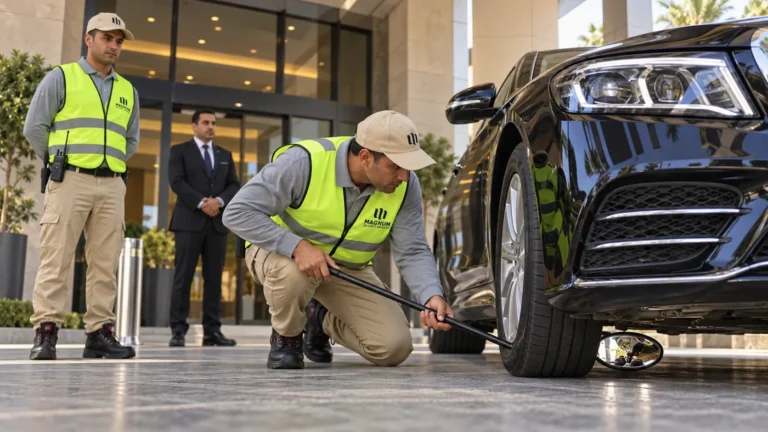
Choosing a security company in Egypt is one of the few procurement decisions where the cheapest proposal can become the most expensive one. Officers who are poorly selected, under-trained or unsupervised create incidents, and incidents create cost, disruption and reputational damage. This guide sets out what international organisations should assess before they sign.
1. Start with your risks, not with headcount
A credible provider will want to visit your site before quoting. Expect questions about entrances, perimeters, operating hours, incident history, the value and location of critical assets, and who visits the site. If a company quotes a number of guards without seeing the site, it is pricing labour rather than designing security.
Ask for the assessment in writing. It becomes the baseline you can measure the service against.
2. Look closely at people
Security is delivered by people on shift, often at night and without a manager present. Ask each bidder to explain:
- How officers are recruited, interviewed and reference-checked
- What background checks are carried out, and how they comply with the law
- What induction training every officer completes before deployment
- How site-specific training is delivered and recorded
- How often refresher training and drills take place
Ask to meet the proposed site supervisor and, for larger contracts, some of the officers. Presentation, language skills and confidence tell you a lot.
3. Supervision is where quality is won or lost
Most guarding failures come from weak supervision rather than bad intentions. Ask how often supervisors visit each post, whether visits are scheduled and unannounced, what they check, and how findings are recorded and corrected. For night shifts, ask how the provider knows officers are alert and patrolling.
Electronic patrol systems, such as QR checkpoints scanned during patrols, give objective evidence that rounds were completed and allow an operations room to follow up immediately when they are not.
4. Ask for evidence of management standards
International standards help separate well-run companies from the rest, provided you understand what each one means:
- ISO 18788 specifies a management system for private security operations, including risk assessment, legal compliance, respect for human rights, personnel, training and incident management.
- ISO 45001 covers occupational health and safety management, which matters because security officers work long shifts in exposed roles.
- ICoCA, the International Code of Conduct Association, promotes responsible private security that respects human rights. Its status levels differ: affiliation, membership and certification are not the same thing.
Ask for certificates, check the scope and expiry date, and verify them with the issuing body. A provider that is vague about the status of its credentials is telling you something.
5. Reporting your organisation can use
Agree key performance indicators before the contract starts and ask to see a sample report. Useful measures include post coverage and attendance, patrol completion, supervisor visits, incident response and close-out, training completion and corrective actions.
| Area | Questions to ask |
|---|---|
| Escalation | Who is called, in what order, for each type of incident? Is there an operations room? |
| Communication | Can supervisors and the operations room work in both Arabic and English? |
| Technology | Will the provider work with your CCTV, access control and visitor systems? |
| Continuity | How are absences covered so that posts are never left empty? |
| Compliance | Are officers paid and contracted lawfully? Are recruitment fees prohibited? |
6. Read the contract for the details that matter
Check the scope of each post, hours, supervision ratios, replacement terms, response commitments, liability and insurance, confidentiality, data protection and how performance problems are resolved. Be cautious of guaranteed response times that ignore Cairo traffic; realistic, measured service levels are more valuable than promises.
7. Plan the transition
If you are replacing a provider, ask how the newcomer will manage the handover: reviewing post instructions, overlapping shifts, briefing site staff and, where appropriate, interviewing incumbent officers. A rushed transition is a period of elevated risk.
A short checklist
- Site assessment completed and documented
- Recruitment, screening and training explained and evidenced
- Named supervisor and clear supervision routine
- Valid, verifiable certificates with relevant scope
- Sample report and agreed KPIs
- Clear escalation matrix and operations support
- Contract terms reviewed by legal and procurement
- Transition plan agreed
If you would like to see how Magnum approaches these questions, read about our security guarding services and verified certifications, or request a proposal.
Frequently asked questions
How do I compare security companies in Egypt?
Compare how each provider assesses risk, selects and trains officers, supervises posts, reports performance and evidences its standards, not only the monthly price per guard.
Is ICoCA affiliation the same as ICoCA certification?
No. ICoCA has different status levels. Affiliation is based on an evaluation of a company’s policies and procedures; membership and certification involve further requirements. Always check the exact status with ICoCA.
Should a security company visit my site before quoting?
Yes. A site assessment is the basis for an accurate proposal and gives you a baseline for measuring the service.